The Flawless-Skin Image Is an Image, Not a Baseline
Learn how lighting, retouching and framing shape a flawless-skin image, so you can read beauty photographs without treating them as everyday standards.
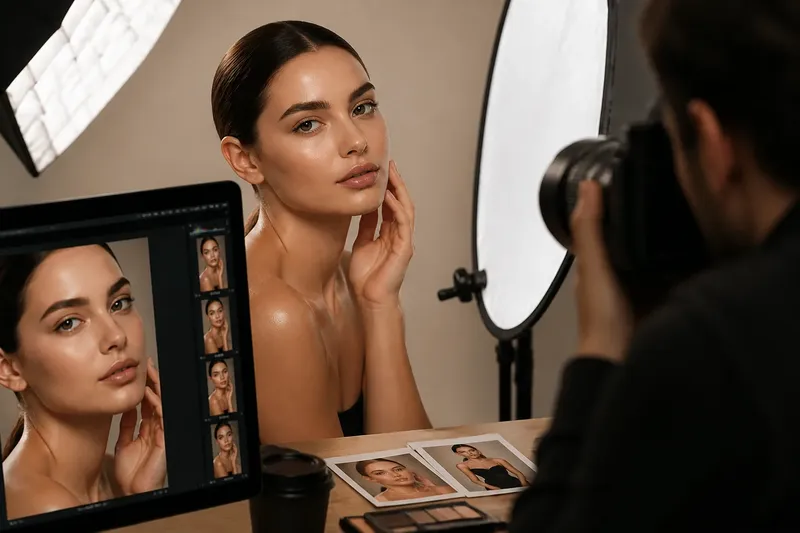
A flawless-skin image can begin with ordinary skin and end with a surface that looks almost frictionless. Lighting, retouching and framing each help produce that effect, but they do so in different ways. Knowing what each choice can change makes it easier to see a beauty photograph as a made image, not a measure of how anyone should look at home, at work or in daylight.
These choices are not equally visible, and none alone tells you exactly how an image was made. Still, looking at them separately offers a useful way to read the picture: ask what the light reveals, what editing may have softened, and what the frame leaves out.
Light shapes the surface
Light affects which details appear prominent. A broad, soft source placed near the camera can reduce the appearance of texture by casting fewer sharp shadows across pores and fine lines. A direct flash or a small, hard lamp may make shine, bumps and unevenness more noticeable. Neither reveals a complete, objective version of a face; each creates a different pattern of highlights and shadow.
Beauty images may also use reflectors or bright surroundings to lift shadow beneath the eyes and around the nose. A white reflector, pale wall or light-coloured card can send light back towards the face, making the overall look more even. The skin itself has not necessarily changed; the contrast around its features has.
For a reader, the practical distinction is between seeing a surface and seeing it under particular conditions. A face photographed in soft studio light is not directly comparable with one seen under a bathroom downlight, on a cloudy street or beside a window. The light changes what the camera records and how the eye reads it.
Retouching edits detail
Retouching can range from simple colour correction to more selective changes. An editor might adjust the overall tone of an image, reduce a temporary blemish, soften shadows or smooth skin texture. These choices can be subtle; a photograph need not look obviously artificial for editing to have altered its impression.
It helps to distinguish adjustments that affect the whole picture from edits focused on skin. Changing brightness or colour balance may shift the appearance of complexion across the frame. Local retouching can make particular patches, marks or lines less visible while leaving other details intact. The result may look plausible, but plausibility is not the same as an untouched record.
Retouching is also not always a simple before-and-after switch. A photographer, brand, editor or platform may shape an image at several points, from the original capture through colour grading and final cropping. Unless the process is disclosed, a viewer usually cannot tell which decisions were made or how extensively. That uncertainty is a reason to avoid treating a polished image as a neutral reference.
Framing selects what counts
A close crop directs attention towards the face and away from the setting. It may exclude the hairline, neck, clothing, hands and the surroundings that would make the photograph feel more like an ordinary encounter. A carefully chosen angle can also favour one side of a face or keep certain shadows outside the frame.
Expression and timing matter too. A still photograph catches one instant: a relaxed expression, a held pose or a moment arranged for the camera. It does not show how the face moves through conversation or how skin appears across a day. A portrait can therefore suggest a stable, uninterrupted finish that no single frame can establish.
Framing is not automatically deceptive. Portraits have always selected what to show; the useful question is what the selection asks the viewer to notice. If the image presents only a smooth cheek in a tight crop, it tells you less about the person’s overall appearance than a wider, less controlled view would.
Three ways to read images
Consider three approaches when a beauty photograph starts to feel like a standard. Each suits a different need, and you can combine them without trying to identify every production choice.
- Read the lighting. Look for soft, even illumination, bright reflections in the eyes, or unusually faint shadows. This suits a quick first pass: it reminds you that apparent smoothness can come from light placement and contrast, not only from skin.
- Look for editing clues. Notice whether texture seems consistent across the face, whether edges look unusually clean, and whether colour appears even in areas that would normally sit in different light. This approach suits close attention to a heavily polished image, though no single clue proves that retouching occurred.
- Widen the frame. Seek other views of the same person, such as a full-length portrait, a short video or a photograph in a less controlled setting. This suits moments when the crop itself is doing much of the persuasive work. Different formats still involve choices, but they can show more movement, context and variation.
Say you see a close-up of a model with a uniformly luminous cheek beside a makeup product. You notice the soft front light, then find a wider image from the same campaign where the cheek catches a stronger shadow. The useful result is not a verdict about whether either photograph is “real”; it is a clearer sense that each view presents selected conditions.
What should you ask?
Does soft lighting remove skin texture?
Soft light can make texture less conspicuous by reducing sharp shadows, but it does not literally remove texture from the skin. Camera exposure, focus and image processing can also affect how much detail remains visible.
Can I tell if a photograph was retouched?
Sometimes an image contains visible signs of editing, but there is no dependable visual test for every kind of retouching. A polished finish may result from lighting, makeup, processing or a combination of choices.
Is an unretouched photograph a neutral standard?
Not necessarily: an unretouched image still reflects its lighting, angle, lens, timing and selection. It may offer a different view, but it is still a photograph made under particular conditions.
Which image is most useful for comparison?
Choose images that show the person in varied settings and at more than one distance, rather than relying on a single close-up. Treat each as one view, not as a complete account of how skin looks in daily life.
Choose the reading, not the ideal
If your aim is to understand a campaign image, start with its lighting and crop; those are often the clearest choices to inspect. If you are trying to judge how much editing may be involved, look across several views rather than treating one smooth surface as evidence. If you simply want to enjoy the photograph, you need not audit it at all.
The phrase “flawless skin” describes an image-making effect as much as a complexion. Keep that distinction close when beauty photographs begin to feel like instructions. A picture can offer inspiration, mood or a product story without setting a baseline for the skin you see in your own mirror.