How the Compact Mirror Found Its Place in the Handbag
Compact mirrors and handbags developed alongside changing habits of carrying personal things. See how cases, hinges and bag design shaped portable grooming.
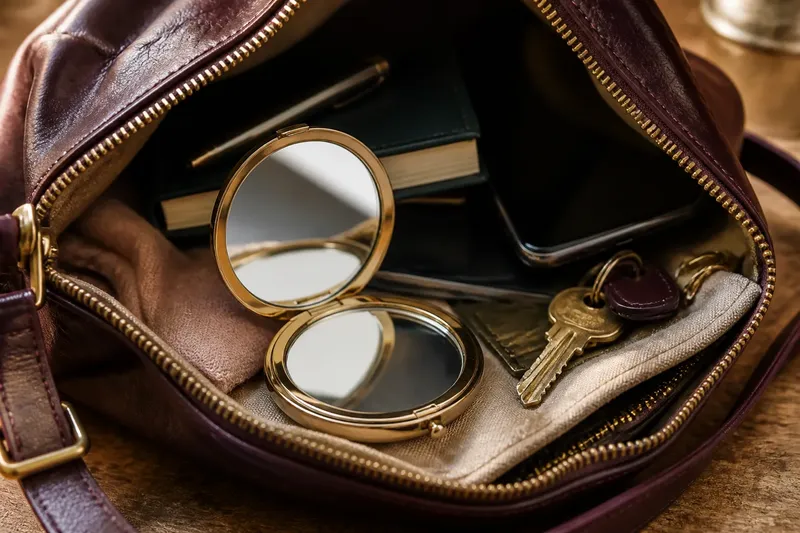
The compact mirror was made to travel, but its story is not simply a tale of arriving before the handbag. Small mirrors and protective cases existed in many forms; the familiar handbag became one of several places to carry them. Looking at specific designs makes their connection clearer: a mirror needed protection, a case made it portable, and a bag gave that portable object a place among other belongings.
Mirrors before handbags
People used reflective surfaces long before the modern compact. Polished metal mirrors are known from ancient societies, while later glass mirrors offered a different, more fragile surface. These objects varied widely in size and setting. Some belonged to domestic rooms; smaller hand mirrors and protected mirrors could be carried, though the precise forms and customs differed across time and place.
That distinction matters. A portable mirror did not require a handbag, and a handbag did not create the desire for one. A small case, pocket, purse or travelling container could carry personal items. The compact belongs to this broader history of objects designed to accompany the body, rather than to a simple sequence in which one accessory replaced another.
Cases and contents
By the time hinged cosmetic cases became familiar accessories, makers were combining mirrors with other useful contents. A compact might hold face powder alongside its mirror, while other small cases carried scent or grooming tools. Such designs brought distinct tasks together in one object, but they also required a case that could close securely and tolerate being moved about.
The hinge and clasp were practical features, not merely decoration. A closed case helped shield the mirror from knocks and scratches; the outer surface also offered room for enamel, engraving or polished metal. A compact could therefore be both a working object and an accessory visible when taken from a bag.
The handbag connection
As handbags became a more ordinary part of dress and daily travel, they offered a convenient home for small personal objects. Their changing shapes and contents helped make the compact useful as a carried item, but they did not establish its original existence. Rather, bag and compact developed in conversation: the compact had to be portable enough to fit among belongings, while the bag made it easier to keep grooming tools close at hand.
Their relationship also depended on social setting. A person might carry a compact in a purse, a pocket or a travel case; someone else might leave a mirror at home and use one available in a dressing room. The handbag made private belongings easier to organise and transport, but carrying a mirror remained a choice shaped by habit, access and the occasion.
Designed for a glance
A compact offers a close view rather than the broad perspective of a full-length mirror. It suits checking a hairline, looking for a smudge or making a small adjustment. Its scale sets a limit: it is not a substitute for a larger mirror when someone wants to assess an entire outfit.
Imagine a commuter carrying a slim compact in a shoulder bag with keys and a notebook. At a station, they notice a strand of hair out of place, open the case, check the reflection and tuck it away again. The compact has helped with one specific adjustment; it has not transformed the setting into a dressing room or dictated what the commuter should change.
Choosing a compact
For someone considering a compact today, the useful questions are practical. A simple mirror-only case is slimmer; a powder compartment adds a second function but takes up more space. A hinged case can protect the mirror, while a loose or damaged clasp may make it less dependable in a bag.
- Check whether the reflection is clear; if it is, choose it for routine checks, but if it is cloudy or distorted, look for another mirror.
- Check whether the clasp stays shut during ordinary handling; if it closes securely, it is suitable for carrying, but if it opens easily, keep it in a protective pouch or choose another case.
- Check whether the hinge opens and closes without catching; if it moves smoothly, it should be convenient to use, but if it sticks or feels loose, treat it as a display piece or have it assessed by a repairer.
- Check whether you will use the powder compartment; if you need that extra function, accept the thicker case, but if not, choose a mirror-only design.
- Check whether the compact fits comfortably in the pocket or bag you plan to use; if it does, it can travel with your usual belongings, but if it crowds them, choose a slimmer form.
- Check the case for sharp edges or flaking material; if the surface is intact, it is ready for ordinary handling, but if it catches fabric or sheds material, store it separately and consider repair.
Say you have a hypothetical small shoulder bag, a phone, keys and a preference for checking hair rather than carrying powder. You compare two imagined compacts: one slim mirror-only case with a secure clasp, and one thicker case with a powder pan that crowds the bag. You check both reflections and hinges; both mirrors are clear, but the thicker case catches on the bag’s lining. The resulting choice is the slim case: it meets the stated need and fits the available space, while the extra powder function offers little benefit for this particular routine.
Questions about compacts?
Did handbags come before compact mirrors?
Small mirrors and cases existed in different forms before the modern handbag became a familiar accessory, but that does not mean every compact design preceded every kind of bag. The useful point is that portable mirrors and containers developed in overlapping histories, not a single, settled sequence.
Why put a mirror in a compact case?
A case protects a fragile reflective surface and makes it easier to carry among other belongings. When the case also holds powder, it combines two grooming tools in one object.
What is the difference between a compact and a hand mirror?
A compact usually closes around its mirror, making it easier to protect in a bag or pocket. A hand mirror is generally held by a handle and may offer a larger view, but is less enclosed when carried.
Are compact mirrors still useful?
They suit people who want a dedicated mirror, prefer not to use a phone screen for a reflection, or value a compact’s design. Their usefulness depends on whether the size and features fit the person’s actual routine.
Portability as design
The compact’s place in the handbag is best understood through its practical details. A closing case protects the mirror; a powder pan adds a function while increasing bulk; a slim shape leaves more room for other belongings. These trade-offs explain why there is no single ideal compact, only forms suited to different ways of carrying and using one.
For a compact mirror, the lasting design idea is not that grooming must happen everywhere. It is that a small, protected object can make a particular glance possible away from home. The handbag provided one useful setting for that object, alongside pockets, purses and travel cases.